
ITL Newsletter
Subscribe to our newsletter for the latest news.
User login
Smart System
Featured Literature


Featured Video

You are here
Radiant Cooling FAQ Part 2
Welcome to part 2 of our radiant cooling FAQ coverage. If you missed the last installment, you can find it here.
Now that you're all caught up, let's dive into this month's questions:
Q: What is a typical room set point in a cooling application?
A: One of the many advantages of a radiant cooling system is the potential for energy cost savings, as illustrated by the ability to design for higher room set points. With forced air cooling systems it is typical to design for as low as 72-74ºF, but with radiant cooling systems it is possible to design for 78ºF or higher while providing higher levels of human thermal comfort (for detailed information on human comfort factors, see ASHRAE Standard 55). This is due to the greater influence of radiant systems on operative temperature over that of forced air.
Q: What is an acceptable relative humidity range?
A: We all know that if you pour a glass of cold water on a hot day and leave it on the counter it will “sweat” as the humidity of the room condensates on the glass. This same process can happen with an improperly designed radiant cooling system, creating all sorts of potential problems down the line. When designing a radiant cooling system is is important to keep the dew point at or above the supply water temperature for the system.
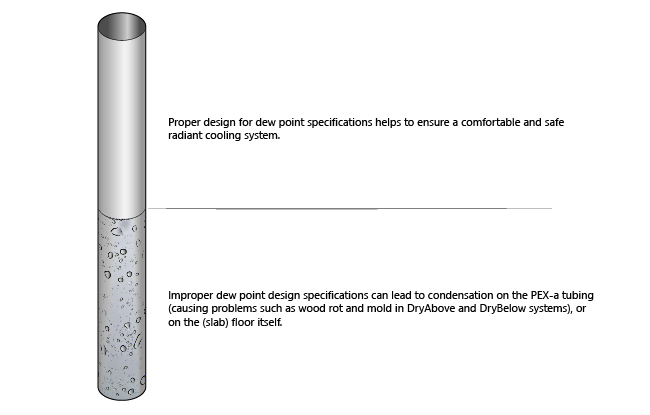
With surface temperature minimums of 66ºF and room set points of 78ºF or higher, the relative humidity may be allowed to run as high as 50%. This provides a significant safety factor and a reasonable time frame to react to changes in dew point before condensation can occur on the cooling surface. The chart below offers a simplified view of dew point settings at Relative Humidity % x Air Temperature..

Watch for Part 3 in the October edition of In the Loop.
©2024 HeatLink Group Inc.
HeatLink, DryBelow, DryAbove, EndBend, HeatSeal, PureLink, SpacerClip, StatLink, and TwistSeal are either trademarks or registered trademarks of HeatLink Group Inc.


Theme by Danetsoft and Danang Probo Sayekti inspired by Maksimer