
ITL Newsletter
Subscribe to our newsletter for the latest news.
User login
Smart System
Featured Literature


Featured Video

You are here
Radiant Cooling FAQ Part 3
Q: What is human thermal comfort?
A: ASHRAE Standard 55 defines thermal comfort as “that condition of mind that expresses satisfaction with combinations of indoor thermal environmental factors and personal factors that will produce thermal environmental conditions acceptable to a majority of occupants within the space.”
ASHRAE has established the standard for Thermal Environmental Conditions for Human Occupancy, or ASHRAE Standard 55 . This standard sets the boundaries for thermal comfort at: 50% RH (Relative Humidity) with 75-80ºF Operative Temperature for the summer (cooling) period.
This is the comfort area that optimizes the percentage of people who are comfortable, with less than 10% being dissatisfied at any moment. ASHRAE Standard 55 sets the floor temperature at 66ºF (cooling) to 84ºF (heating) for optimal occupant comfort.
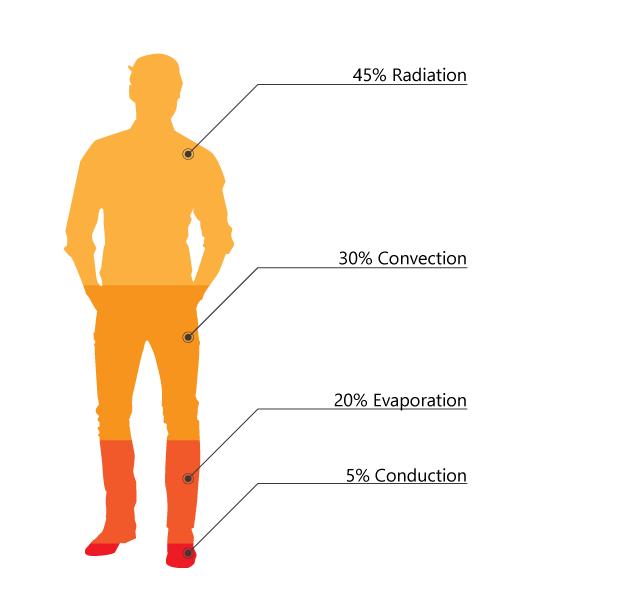
This graphic shows the breakdown of human thermal regulation through heat transfer methods.
Q: What is Local Thermal Discomfort?
Local Thermal Discomfort is anything that causes human thermal comfort to be disrupted or otherwise not reached.
The main culprits of thermal discomfort are:
Radiant Asymmetry, which occurs when the thermal radiation field surrounding the body is not uniform due to differing surface temperatures. This is often caused by direct sunlight, but occurs anytime there are large temperature differences between surfaces in a room.
Vertical air temperature can influence thermal comfort through stratification of the air temperature. This can result in air that is warmer at head level and cooler at ankle level, which is less favorable and more common than the reverse.
Floor surface temperature can become uncomfortable for occupants if it is too warm or too cool (the standard only addresses comfort for occupants wearing footwear).
©2024 HeatLink Group Inc.
HeatLink, DryBelow, DryAbove, EndBend, HeatSeal, PureLink, SpacerClip, StatLink, and TwistSeal are either trademarks or registered trademarks of HeatLink Group Inc.


Theme by Danetsoft and Danang Probo Sayekti inspired by Maksimer